Nando’s Order at Table
Four markets, four separately-built ordering apps, no shared standard. One audit that turned that into a single journey — and a £500M opportunity.
Agency
AKQA
UX Lead
Role
UX Director oversight (AKQA); client-side Global Head of Brand & Global Head of Tech as close collaborators
Team
AU • US • UK • ZA
Markets
Audit • Competitive research • Synthesis • Customer journey • Presentation
Scope
£500M+
Sales opportunity identified across the four markets
4 → 1
Divergent market experiences aligned to one Nando’s journey
CMO
Level alignment – presented to global brand, tech and the CMO
01 – IMPACT
Created a shared standard to invest in across markets, and a clear view of which features moved revenue for order at table.
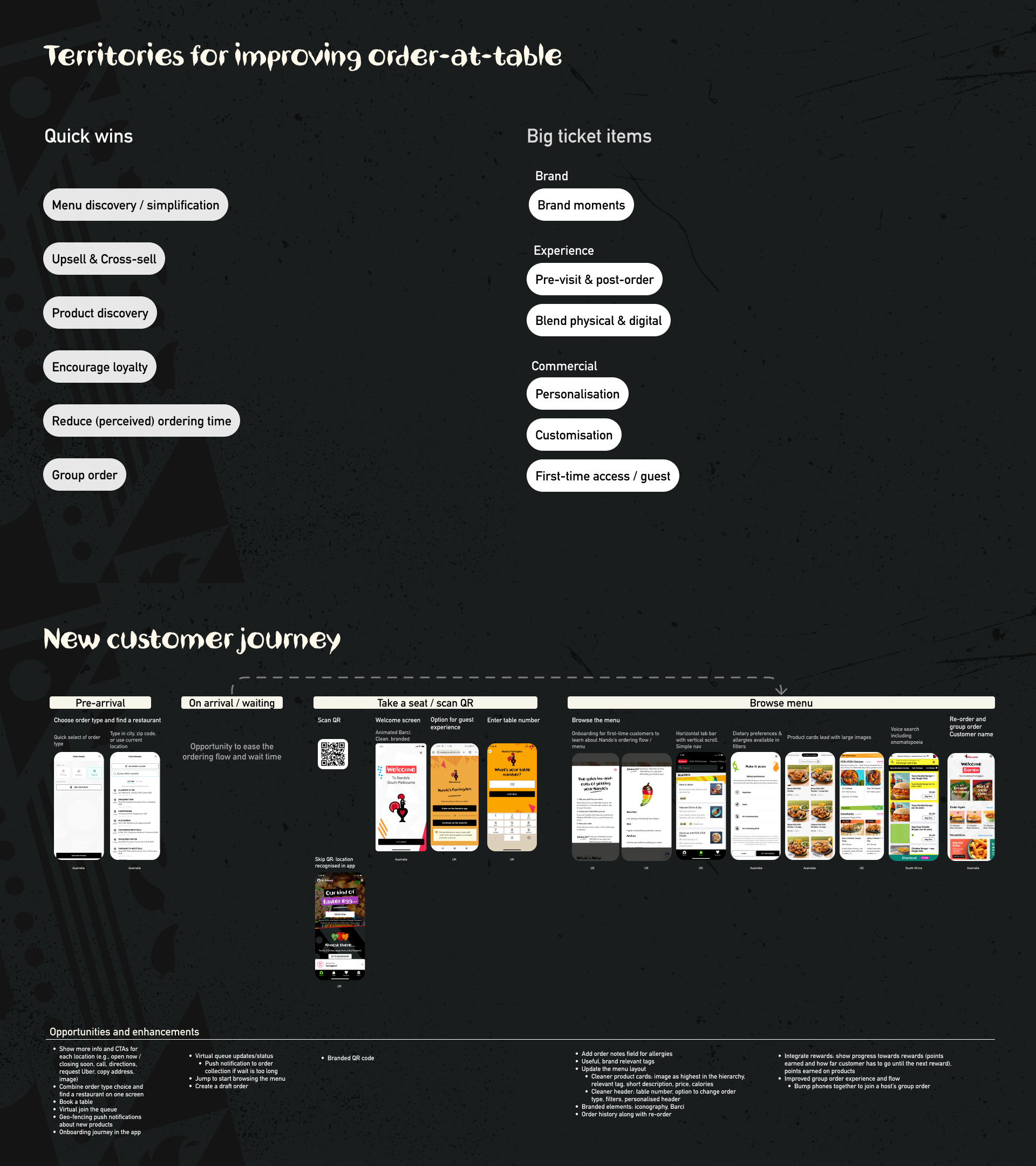

I aligned four independently-built order-at-table experiences into one journey.
I owned the audit, competitive research, and synthesis end-to-end. I shaped presentations with the client's global heads of brand and tech given the internal sensitivity, then presented directly to the global team — brand, tech, and CMO — to land executive alignment. Our UX Director joined later for a broader stakeholder readout.
I built a strong and trusting relationship with the client as well. When I moved on to another project, the client asked for me back.
02 – SETUP
The brief was two-fold: a brand problem — consistency, recognizably Nando's, across markets — and a revenue opportunity we surfaced once we dug in: increase basket size, purchase frequency, recency, and personalization.
During the pandemic, each of Nando's markets built its own order-at-table QR experience with no shared standard between them. The global team commissioned the audit to bring them into one consistent Nando's experience.
Through stakeholder interviews, we also learned that order at table is uniquely placed to increase basket size, purchase frequency, recency, and personalization, because selling ancillary items, bundles, and acting on data is easier in a digital environment.
The brief said audit four apps, but what it needed was someone willing to find out where each market was falling short, and why, before recommending anything.
03 – PROCESS
Grounding first:
Lived experience helps me close the distance between me and the problem – something unattained from analyzing flows and data.
I dined at Nando’s in London with our client first, giving me key observations I couldn’t have picked up from assumptions, data analysis, or user flow analysis.
Felt the wait time
Staff scramble to find a table, chaos of takeout orders coming in at the same time, lots of movement and energy at the entrance
Reliance on staff and training to make order at table work
Not all staff point out the QR when they seat you; awareness becomes harder
Major gaps: allergies and customizations are not covered
Customers with allergies or customized items have to go up to the counter to order
Group ordering felt clunky
Awkward to pass around 1 phone, everyone in the party is ready to order at different times so others are waiting if someone is slower to decide or new to Nando’s
South African culture is integrated through music and art
Nando’s is one of the largest exporters of South African art. The art adds more color and liveliness to the space. Playlists are curated per country and follow the rhythm of the restaurant – slower during lulls and faster in busier times.
Part 1: The full audit
Went market by market, screen by screen, scoring each against usability, brand, functionality and navigation out of 5 per category, averaged into a total, plotted on a perceptual map.
This version went to the global team, and it was genuinely sensitive, close to marking each market’s homework.
Example: instead of asking “how was ordering with our app?”, reframe toward the actual taste preference, so the experience can start personalising around it.
Part 2: Sanitized and actionable
Same audit, reworked for the markets themselves rather than the global team. No grade this time.
Categories expanded (experience design, content, navigation, functionality) and everything reframed as a specific opportunity per screen, per market: something each market could actually act on.
Part 3: Into the journey, then the synthesis
Recommendations moved from a list into the actual journey, placed exactly where they’d land as someone orders. Tags are the clean example: not instinctive enough across markets, so we explained why tagging mattered, then pointed to best-in-class for what good looks like.
That fed the final move: a “Frankenstein” journey, the best ideas from all four markets plus patterns borrowed from best-in-class (Sweetgreen, Airbnb), combined into one new, cohesive customer journey.
04 – AI IN THE WORKFLOW

Across four markets, this project generated a huge volume of qualitative feedback from 17 stakeholders. Analyzing that much material by hand would have taken weeks.
Using AI — ChatGPT and FigJam's AI — to synthesize it into themes let me move much faster. But more than that, it let me go deeper: spotting patterns across markets I'd have missed skimming transcripts alone, and freeing up time to sit with what actually mattered and sharpen my judgment on what to prioritize and how to frame it back to stakeholders.
05 – CLOSE
Bringing clarity and creating a direction that let everyone else build what is ahead
The audit, recommendations, and direction setting it produced fed directly into Nando's business strategy for the period ahead: a structured view of where each market was falling short, recommendations to improve the order-at-table experience, and a clear set of prioritized next steps.
IF I DID IT AGAIN TODAY
Visualize the recommendations. Concepting what each change looks like for Nando's specifically would have made the recommendations land harder than reference examples alone.
Pair the embodied experience with customer research. Talking to actual diners and pushing an incentivised survey through the apps would have grounded the findings in real customer data, in addition my own observations of the experience.
Define success metrics upfront. Building measurement into the recommendations would let Nando's track how much of the £500 million opportunity they're capturing over time.
Share of all orders placed on order-at-table
Basket size difference between orders placed at the counter and order-at-table
Repeat order-at-table rate in a specific time period to confirm if behavior changed